
IUI vs IVF: What Is the Difference
Short answer
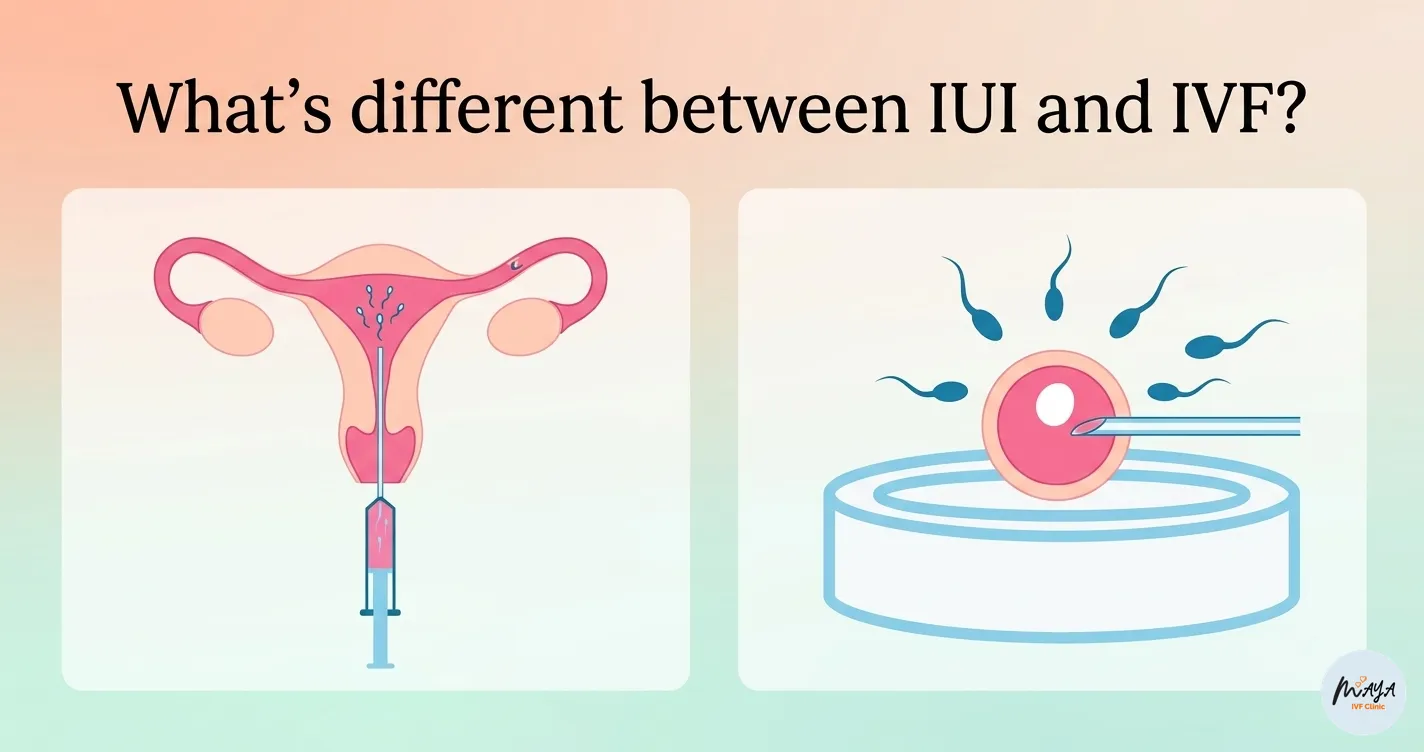
IUI (intrauterine insemination) places prepared sperm into the uterus around ovulation, and fertilization happens inside the body. IVF (in vitro fertilization) collects eggs, fertilizes them with sperm in a laboratory, and then transfers an embryo to the uterus or freezes it for later. IUI is less invasive and costs less per cycle. IVF has more steps, does not depend on open fallopian tubes, and gives doctors more control over fertilization. Neither is better for everyone. The right choice depends on the diagnosis, age, ovarian reserve, sperm results, tubal status and treatment history.
Key takeaways
Where fertilization happens: inside the body with IUI, in a laboratory with IVF.
Tubes: IUI needs at least one open fallopian tube. IVF bypasses the tubes.
Chances: IUI and IVF cannot be ranked with one pair of percentages. They are used for different diagnoses and are measured in different ways.
Cost: IUI is cheaper per cycle, but the total depends on how many cycles are needed.
Guidelines differ and have changed: a 2026 UK guideline (NICE) now allows up to four stimulated IUI cycles before IVF for unexplained infertility. European guidance (ESHRE) recommends stimulated IUI as first-line for the same group. Many older web pages still say the opposite.
Testing comes first: The decision should follow test results, not preference or price alone.
What is the difference between IUI and IVF?
The difference is where fertilization takes place and how much of the process is handled in a laboratory.
In IUI, a semen sample is washed and concentrated in the laboratory. The prepared sperm is placed through a thin catheter into the uterus around the time the ovary releases an egg. The sperm must still reach and fertilize the egg inside the fallopian tube. No eggs are collected, and no embryo is created outside the body.
In IVF, medicines stimulate the ovaries to develop several eggs. The eggs are collected in a minor procedure, combined with sperm in the laboratory, and grown for several days. An embryologist monitors development, and the embryo or embryos chosen for transfer are placed in the uterus. Remaining embryos may be frozen (cryopreserved).
IUI is less invasive than IVF and has fewer laboratory steps. It is still a medical treatment, not the same as trying naturally.
IUI vs. IVF at a glance
How does IUI work?
An IUI cycle is timed around ovulation, the release of an egg from the ovary.
Assessment first: Before IUI, doctors check ovulation, semen quality and the fallopian tubes. Tubes are usually checked with an X-ray test (hysterosalpingogram, HSG) or an ultrasound with contrast (HyCoSy).
Timing: Ovulation is tracked with ultrasound, hormone tests or ovulation kits. Some plans add tablets or injections to encourage the ovaries to release one or more eggs. A trigger injection may be used to time ovulation.
Sperm preparation: The semen sample, from a partner or donor, is processed so that healthy, moving sperm is concentrated.
Insemination: A catheter passes through the cervix and places the sperm in the uterus. It takes a few minutes, and most people go home after a short rest.
The wait: A pregnancy test is usually done about two weeks later, on the date your clinic gives you.
Because the egg and sperm meet inside the body, IUI can only work if ovulation occurs, at least one fallopian tube is open, and enough healthy sperm reach the egg.
How does IVF work?
IVF has more stages, and the laboratory is involved at each one:
Ovarian stimulation and monitoring: Daily hormone injections encourage several follicles to grow. Scans and blood tests guide the dose.
Trigger injection and egg retrieval: A trigger injection matures the eggs. About 36 hours later, a thin needle guided by ultrasound collects them, usually under sedation or anesthesia.
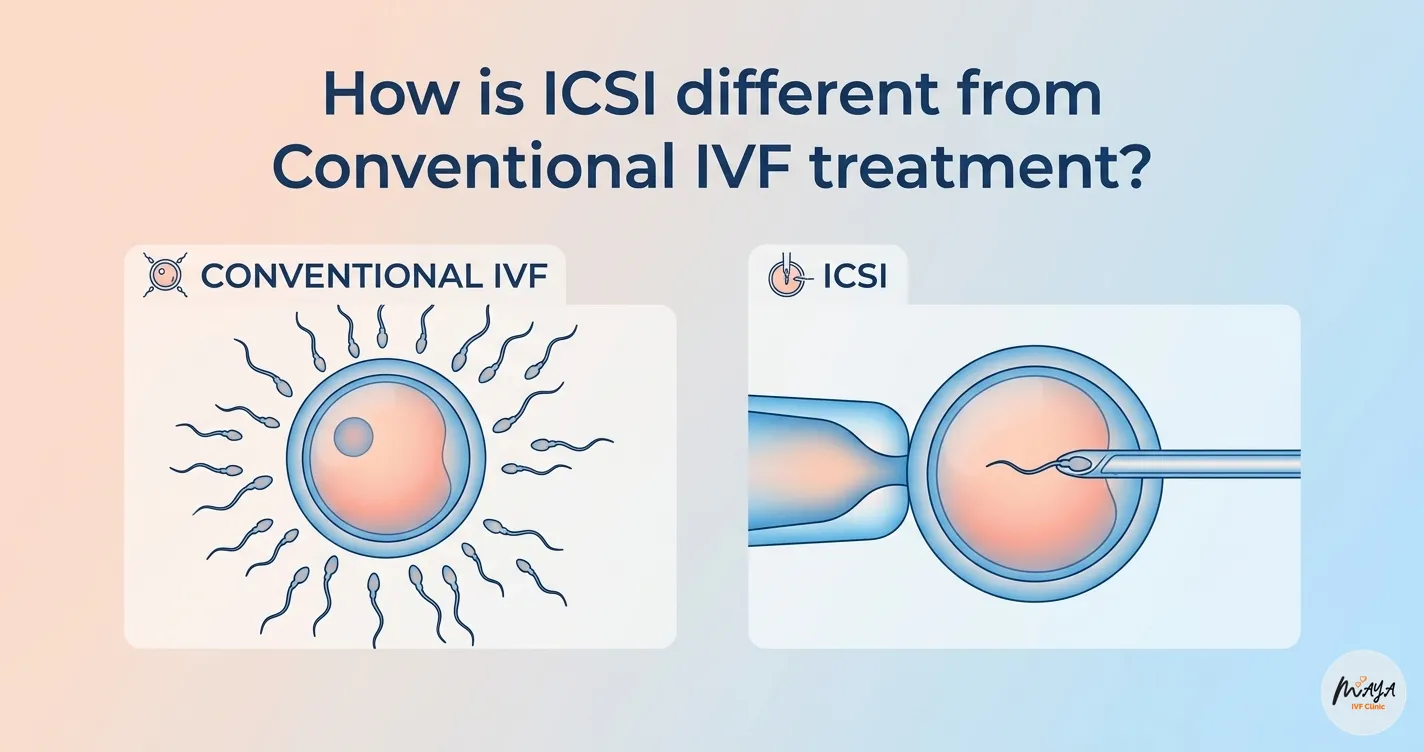
Fertilization: The laboratory fertilizes the eggs with prepared sperm. Where sperm quality is a concern, intracytoplasmic sperm injection (ICSI) places a single sperm into an egg. See ICSI vs conventional IVF.
Embryo culture: Embryos are grown in an incubator and watched by an embryologist, usually for up to six days.
Transfer or freezing: One or more embryos are transferred, or embryos are frozen for a later transfer.
Pregnancy test: About two weeks after transfer, on your clinic's schedule.
For the full sequence, read our guide on how the IVF process works step by step.
Is IUI less invasive than IVF?
Yes, IUI needs no egg collection and usually no anesthesia, and most people resume normal activity at once. IVF involves injections, frequent monitoring, and a minor procedure to collect eggs. Less invasive is not the same as lower risk or higher efficiency. A lighter procedure can mean more attempts, and stimulated IUI carries a real chance of twins or more.
Which treatment suits which diagnosis?
This table shows how a fertility specialist may think about the choice. It is a guide to the reasoning, not a rule.
When is IUI usually considered?
A fertility specialist may consider IUI for unexplained infertility, ovulation problems after assessment, donor sperm, difficulty with intercourse for medical or psychosexual reasons, and selected cases of mild male-factor infertility.
IUI is not suitable for blocked fallopian tubes. It is generally less helpful with significantly reduced ovarian reserve or significant sperm problems. That is why testing comes first.
Why guidance on unexplained infertility now differs
For years, UK NICE guidance advised against IUI for unexplained infertility, and many websites still repeat this. In March 2026, NICE published a revised guideline (NG257). It advises up to two years of trying before treatment, says ovarian stimulation should not be offered on its own, and says that up to four cycles of IUI with gonadotrophin stimulation can be considered before IVF, or IVF can be offered.
European guidance goes further. The 2023 ESHRE guideline strongly recommends IUI with ovarian stimulation as first-line treatment for unexplained infertility, and it advises basing the decision to start treatment on the couple's prognosis. It judges IVF as probably not recommended over stimulated IUI in this group. Some professional societies suggest three to four stimulated IUI cycles before moving to IVF.
These are UK and European recommendations. Your plan depends on your own results and your doctor's judgement.
When is IVF usually considered?
A fertility specialist may consider IVF when IUI is unlikely to work or has not worked:
Blocked or damaged fallopian tubes, because fertilization cannot happen in the body.
More significant male-factor infertility, often with ICSI.
Reduced ovarian reserve or older age, where time and egg numbers limit chances.
Endometriosis, in selected cases.
Unexplained infertility, after evaluation or unsuccessful IUI.
Previous unsuccessful treatment, or where embryo freezing or genetic testing is part of the plan.
Fertility preservation or donor treatment, where medically and legally appropriate.
Which has a higher chance of pregnancy, IUI or IVF?
No honest single pair of percentages ranks the two. IUI and IVF are used in different patients, are counted differently (per cycle, per embryo transferred, or cumulatively), and are affected by age, diagnosis, ovarian reserve, sperm quality, egg and embryo quality, previous treatment, and laboratory factors.
Be cautious with clinic pages that print an IUI percentage next to an IVF percentage. They often mix populations or measures, and their figures rarely cite a source. Success claims on some pages are far above published national data and also differ widely from one another.
For perspective on IVF only, the UK regulator HFEA reported for 2023 an average birth rate of 25% per fresh embryo transferred using the patient's own eggs, 35% at ages 18 to 34 and 5% at ages 43 to 44. These are preliminary UK figures, measured per embryo transferred. They are not Nepal data, and they should not be set against IUI per-cycle rates.
What can be said with confidence:
IVF does not depend on open tubes, so it is the more logical option where IUI has little chance.
IUI may need several cycles, so cumulative chances matter more than one cycle.
Age affects both treatments, and chances fall as age rises.
Ask any clinic for outcome figures for your age group, how they are counted, and which years they cover.
How much do IUI and IVF cost?
IUI costs less per cycle than IVF because it needs fewer procedures and less laboratory work. The fair comparison is the likely total for the full plan, not one cycle. Repeated IUI cycles add up, and IVF packages vary in what they include.
Costs depend on:
consultation and fertility testing
medicines
scans and blood tests
sperm preparation
egg retrieval and anesthesia (IVF)
ICSI, if needed
embryo culture, transfer, freezing, and storage
follow-up visits
Prices quoted online are often a "starting from" figure that leaves out medicines or add-ons. Confirm current packages and additional charges directly with the clinic, ask what is included, and ask what happens to the cost if a cycle is stopped or changed.
How long does each treatment take?
An IUI attempt follows your menstrual cycle, so one attempt takes roughly one cycle from tracking to pregnancy test. A fresh IVF cycle usually takes a few weeks from the start of stimulation to the pregnancy test. A frozen embryo transfer adds preparation time. Timing depends on your protocol, your response to medicines, and the clinic's schedule.
What are the risks and limitations?
IUI
Multiple pregnancy, mainly when stimulation produces more than one egg. Evidence reviewed by NICE found fewer multiple pregnancies with unstimulated IUI.
Mild cramping. Infection is uncommon but possible.
It may not work, and repeated cycles may be needed.
IVF
Side effects from medicines, such as bloating and mood changes.
Ovarian hyperstimulation syndrome (OHSS), uncommon but potentially serious.
Risks linked to egg retrieval and anesthesia.
Multiple pregnancy, depending on the number of embryos transferred.
Emotional and financial strain, and no guarantee of pregnancy.
Seek urgent medical help for severe abdominal pain, rapid swelling, breathlessness, or heavy bleeding during treatment.
Which is better: IUI or IVF?
Neither is better for everyone. The choice depends on the cause of infertility, age, ovarian reserve, sperm parameters, fallopian tube status, previous treatment, and your goals.
IUI may be reasonable when the tubes are open, ovulation can be achieved, sperm results are adequate, and age leaves time to try. IVF may be the more logical starting point when tubes are blocked, sperm problems are significant, ovarian reserve is low, or age leaves little time. A specialist's role is to match treatment to the diagnosis and explain the reasoning, and you should share the decision.
Can you move from IUI to IVF?
Yes. Treatment plans are reviewed as they go. A specialist may suggest moving to IVF if several IUI cycles have not worked, if the response to medicines is poor, if test results change the picture, or if age makes time a concern. Moving on does not mean the earlier treatment was a mistake. It often provides useful information.
What tests come before the decision?
IUI vs IVF should not be decided without testing. The usual work-up looks at:
Ovulation: cycle history and, where needed, hormone tests.
Ovarian reserve: markers such as AMH and an antral follicle count on ultrasound.
Semen analysis: sperm count, movement, and shape.
Fallopian tubes and uterus: imaging, such as HSG or a contrast ultrasound (HyCoSy).
Our page on fertility assessment and diagnostics explains these tests. For a wider look at causes, see infertility and IVF. The fertility team at Maya IVF Clinic includes fertility specialists, an andrologist, and clinical embryologists, and you can read their profiles on the fertility team.
Questions to ask before choosing IUI or IVF
Have my fallopian tubes been checked, and are they open?
What do my semen analysis and ovarian reserve results show?
Is my diagnosis one where IUI has a reasonable chance?
How many IUI cycles do you suggest before we review the plan, and why that number?
Would the plan include ovarian stimulation, and what is the risk of twins?
At what point would you recommend moving to IVF?
What outcome figures can you show for my age group, how are they counted, and for which years?
What does the quoted cost include, and what is charged separately if the cycle is changed or stopped?
If my partner lives abroad or travels for work, how can the timing of the semen sample be arranged, and is a frozen sample an option?
Is the clinic registered with the relevant health authority, and can I see that registration?
When should you see a fertility specialist?
The American Society for Reproductive Medicine advises evaluation after 12 months of trying if the woman is under 35, and after 6 months if she is 35 or older. For women over 40, more immediate evaluation and treatment may be warranted. Evaluation should start immediately if there is a known cause, such as irregular or absent periods, known tubal or uterine problems, endometriosis or a known sperm problem. An evaluation is a conversation about your options, not a commitment to treatment.
Frequently asked questions
What is the main difference between IUI and IVF?
IUI places prepared sperm in the uterus and fertilization happens inside the body. IVF fertilizes eggs with sperm in a laboratory, and an embryo is then transferred to the uterus or frozen.
Is IUI the same as artificial insemination?
IUI is a form of artificial insemination and is often called by that name. Insemination can also be done at the cervix, which is a different procedure with lower chances, so "IUI" is the more precise term.
Does IUI hurt?
Most people feel mild cramping or pressure, similar to a cervical smear. Anaesthesia and pain relief are not normally needed.
Is IVF more successful than IUI?
They are not directly comparable. IVF does not depend on open tubes and offers more control, so it may suit some diagnoses better. IUI may work for others, sometimes over several cycles. Age and diagnosis matter more than the treatment name.
Can IVF be done without trying IUI first?
Yes. IUI is not a mandatory first step. If tests show IUI is unlikely to work, a doctor may go directly to IVF.
Does IUI need open fallopian tubes?
Yes. At least one healthy, open tube is needed because fertilization takes place inside the body.
How many IUI cycles are tried before IVF?
There is no single number. Guidelines and clinics differ, and the answer depends on your age, diagnosis and response. Ask your specialist what they recommend and why.
Does IVF always mean twins?
No. The chance of twins depends mainly on how many embryos are transferred, and single embryo transfer is often advised where it suits the patient.
Is IUI or IVF better for unexplained infertility?
Guidelines differ. The UK's 2026 NICE guideline allows up to four stimulated IUI cycles before IVF, or IVF directly. ESHRE recommends stimulated IUI as first-line. Your doctor will weigh your age, how long you have been trying and your test results.
Our Latest Blogs

Infertility Myths and Facts in Nepal: What Couples...
Quick AnswerInfertility affects an estimated 1 in 6 people globally during their reproductive years,...
How Is ICSI Different From Conventional IVF Treatm...
Quick answer: Conventional IVF places sperm and eggs together in a dish and allows fertilization to...
5 Common Causes of Infertility in Women
OverviewWhen months pass without a positive pregnancy test, worry tends to creep in quietly. If that...

 Nepal International Fertility and Laparoscopic Centre (NIFLC).
All rights reserved.
Nepal International Fertility and Laparoscopic Centre (NIFLC).
All rights reserved.