
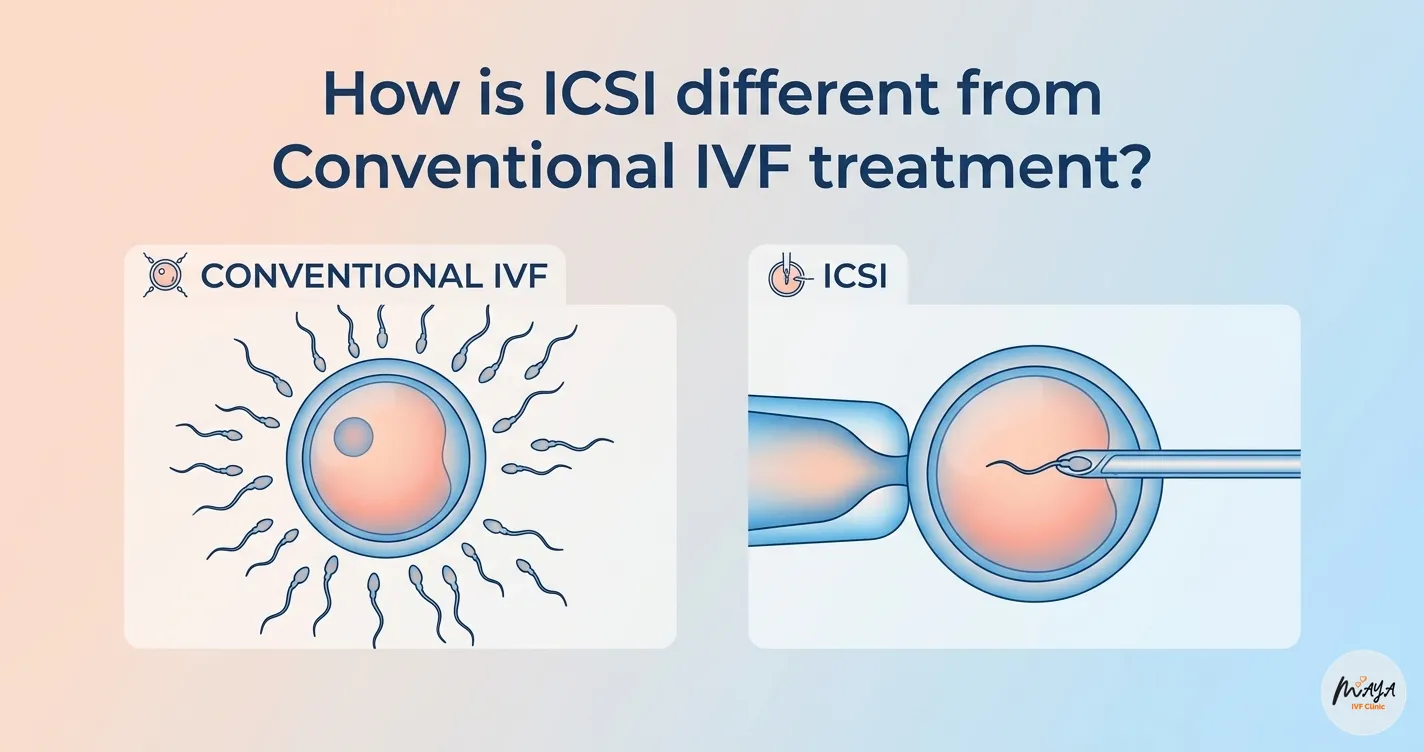
ICSI and Conventional IVF procedures, highlighting fertilization methods, male infertility factors, and treatment options at Maya IVF Clinic.
Blog Details
- Home
- Blog Details
How Is ICSI Different From Conventional IVF Treatment?
Quick answer:
Conventional IVF places sperm and eggs together in a dish and allows fertilization to happen on its own. ICSI (Intracytoplasmic Sperm Injection) is a technique used during IVF in which an embryologist injects a single sperm directly into a mature egg. The core difference lies in how fertilization happens in the lab; the rest of the treatment cycle is the same for both approaches.
What Is Conventional IVF?
In conventional in vitro fertilization (IVF), a woman undergoes ovarian stimulation and egg retrieval. On the day of retrieval, the eggs are placed in a dish together with a prepared sperm sample, usually tens of thousands of motile sperm per egg, and left in an incubator overnight. Fertilization occurs when a sperm penetrates an egg on its own, without lab intervention. The embryologist checks the following morning to see how many eggs fertilized normally.
Conventional IVF relies on sperm being able to swim, bind to the egg's outer layer, and penetrate it unassisted, essentially replicating natural fertilization outside the body.
What Is ICSI?
Intracytoplasmic sperm injection (ICSI) is a laboratory technique used during an IVF cycle in which an embryologist selects a single sperm and injects it directly into the cytoplasm of a mature egg, using a fine glass needle under a microscope. This bypasses the steps a sperm would normally need to complete on its own, such as swimming to the egg and penetrating its outer layers.
Everything else in the cycle, including ovarian stimulation, monitoring, egg retrieval, embryo culture, and embryo transfer, is identical to conventional IVF. ICSI changes only the fertilization step itself. At Maya IVF Clinic, couples exploring IVF treatment in Nepal receive both options as part of a personalized, cause-based treatment plan rather than a default protocol.
ICSI vs Conventional IVF: Key Differences
When Is ICSI Recommended?
ICSI is a targeted tool, not a universal upgrade. Professional bodies, including the American Society for Reproductive Medicine (ASRM) and the European Society of Human Reproduction and Embryology (ESHRE), describe it as indicated in specific situations rather than for routine use in every cycle. Commonly accepted indications include:
Male-factor infertility: Low sperm count (oligozoospermia), poor sperm motility (asthenozoospermia), abnormal sperm morphology (teratozoospermia), or very low sperm counts requiring surgically retrieved sperm.
Previous fertilization failure: Patients who experienced fertilization failure with conventional IVF in a previous cycle.
Very few eggs retrieved: When the clinic aims to reduce the risk of complete fertilization failure due to the limited number of available eggs.
Use of frozen eggs or IVM: When using previously vitrified (frozen) eggs or eggs matured in the laboratory through in vitro maturation (IVM).
Preimplantation genetic testing (PGT): ICSI may be used to reduce the risk of DNA contamination from additional sperm adhering to the egg's outer layer, helping ensure a reliable genetic test.
Unexplained infertility: ICSI may be considered in some cases, although evidence of a live-birth benefit remains limited (see below).
Some clinics apply ICSI to every cycle regardless of indication, an approach often called "ICSI for all." Both ASRM's committee opinion and ESHRE-affiliated researchers have specifically cautioned against this practice; see the next section.
ICSI for Male-Factor Infertility
Male-factor infertility is the clearest, most evidence-supported reason to use ICSI. Common findings include:
Oligozoospermia: low sperm concentration or count
Asthenozoospermia: reduced sperm motility, or movement
Teratozoospermia: a high proportion of abnormally shaped sperm
Azoospermia: No sperm in the ejaculate, requiring surgical sperm retrieval (for example, TESA or TESE)
When sperm numbers or function are too poor for sperm to reliably penetrate an egg on their own, injecting a single selected sperm directly into the egg removes that barrier. This is the original clinical purpose ICSI was developed for, and it remains its strongest, least-disputed indication.
At Maya IVF Clinic, male-factor cases are evaluated by Dr. Robin Bahadur Basnet, a senior consultant urologist and andrologist with 15 years of experience in the diagnosis and surgical management of male infertility, including varicocele treatment and surgical sperm retrieval. Couples with a male-factor diagnosis can also review the clinic's male fertility solutions, including TESA, PESA, TESE, and PICSI sperm-selection techniques used alongside ICSI.
Is ICSI Better Than Conventional IVF?
Not automatically, and not for every patient. This is one of the most misunderstood aspects of ICSI marketing, so it is important to be precise about what the evidence actually shows.
For couples with male-factor infertility, ICSI clearly improves the chance of fertilization occurring at all. This is well established and is why it is the standard of care in that group.
For couples without a male-factor diagnosis, the best current evidence does not show that ICSI improves outcomes, and the largest and most recent trial available found the opposite:
The INVICSI trial (Nature Medicine, 2025) — an open-label, multicenter randomized controlled trial of 824 women across six public fertility clinics in Denmark — found a cumulative live-birth rate of 43.2% with ICSI versus 47.3% with conventional IVF (risk ratio 0.91). The researchers concluded that conventional IVF should be the preferred first-line treatment for patients with normal or non-severely decreased sperm quality, with ICSI reserved for severe male-factor infertility. A secondary analysis found the effect was more pronounced in women 32 or younger.
ASRM's committee opinion on non-male-factor ICSI states that routine ICSI in these cases may not only lack benefit but could also reduce the chance of live birth compared with conventional insemination.
A large Canadian registry study of over 140,000 egg retrieval cycles similarly found a higher cumulative live-birth rate with conventional IVF than with ICSI in couples without male-factor infertility (38.5% vs. 36.3%).
ESHRE-affiliated researchers have publicly stated that "ICSI for all" does not improve clinical outcomes and recommend reserving it for its established indications.
Does ICSI Increase Fertilization Rates?
It depends on the population. In couples with male-factor infertility, ICSI meaningfully reduces the risk of total fertilization failure, because it removes the sperm's need to swim to and penetrate the egg unassisted. In couples without male-factor infertility, the INVICSI trial found conventional IVF achieved a higher fertilization rate per oocyte retrieved than ICSI (58.1% vs. 53.5%), consistent with earlier studies. ICSI is not a reliable way to fertilize more eggs when there is no sperm problem to solve.
Does ICSI Increase Pregnancy or Live-Birth Chances?
This is a distinction patients are rarely given clearly: fertilization rate, embryo development, clinical pregnancy, and live birth are four different outcomes, and a technique that helps with one does not automatically help with the others.
Fertilization rate indicates whether an egg and sperm combined to form a two-pronuclear (2PN) zygote, a lab-level result.
Embryo development indicates whether that fertilized egg grows into a usable embryo.
Clinical pregnancy confirms that an ongoing pregnancy is detectable, usually by ultrasound.
Live birth is the outcome that matters most to patients, and it is not guaranteed by success at any earlier stage.
In non-male-factor cases, higher fertilization with ICSI, when it occurs at all, has not translated into higher live-birth rates in the largest studies available—and in the 2025 INVICSI trial, conventional IVF outperformed ICSI on both fertilization rate and cumulative live birth. [1][3] Treat any claim that cites only a fertilization-rate improvement with caution, since it is not the same as a live-birth improvement.
Is ICSI Necessary for Every IVF Cycle?
No. Major professional bodies, including ASRM and ESHRE, do not recommend routine ICSI for every IVF cycle regardless of diagnosis. ICSI adds cost and lab complexity, and outside its established indications, it has not been shown to improve the outcome that matters most: live birth. Some clinics use it in all cycles as a matter of policy; this is a clinic-level choice rather than a guideline-based standard, and patients are entitled to ask why it is being recommended in their specific case.
What Are the Limitations or Risks of ICSI?
Cost: ICSI requires more embryologist time, specialized equipment, and per-egg handling and is priced higher than conventional IVF.
No guaranteed benefit outside its indications: as detailed above, using ICSI without a clinical reason does not reliably improve live-birth chances and may modestly reduce it in some patient groups.
Egg handling risk: because each mature egg is individually injected, there is a small risk of mechanical damage to the egg during the procedure, though rates are low in experienced labs.
It does not fix underlying issues such as poor egg quality. ICSI addresses a fertilization access problem, not egg or embryo quality itself.
Cost: ICSI requires more embryologist time, specialized equipment, and per-egg handling and is priced higher than conventional IVF.
No guaranteed benefit outside its indications: as detailed above, using ICSI without a clinical reason does not reliably improve live-birth chances and may modestly reduce it in some patient groups.
Egg handling risk: because each mature egg is individually injected, there is a small risk of mechanical damage to the egg during the procedure, though rates are low in experienced labs.
It does not fix underlying issues such as poor egg quality. ICSI addresses a fertilization access problem, not egg or embryo quality itself.
How Do Doctors Decide Between Conventional IVF and ICSI?
The decision is typically based on:
Semen analysis results, including count, motility, and morphology, compared against WHO reference values
History of previous fertilization failure with conventional insemination
Number and quality of eggs retrieved
Whether preimplantation genetic testing is planned
Whether eggs are fresh or previously frozen and thawed
Patient- and clinic-specific factors, discussed directly with the fertility specialist and embryology team
A patient without male-factor infertility and no history of fertilization failure has a reasonable, evidence-based question to ask their clinic: why is ICSI being recommended in this specific case?
ICSI vs IVF Cost in Nepal
Costs for ICSI and conventional IVF vary depending on the clinic, the medication protocol used, and the individual treatment plan. Because ICSI involves additional embryologist time and specialized equipment, it is typically priced higher than conventional IVF. Patients are encouraged to request an itemized quote directly from the clinic rather than relying on general figures found online, since pricing can change and depends on personal diagnostic factors.
Frequently Asked Questions
What is the main difference between ICSI and conventional IVF?
Conventional IVF allows sperm to fertilize the egg on its own in a dish. ICSI involves an embryologist injecting a single sperm directly into the egg. The rest of the IVF cycle is the same for both.
Is ICSI more successful than IVF?
Only in cases of male-factor infertility, where it clearly reduces fertilization failure. In couples without a male-factor diagnosis, the largest randomized trial to date (2025) found conventional IVF achieved a higher cumulative live-birth rate than ICSI.
Who needs ICSI?
Patients with low sperm count, poor motility, abnormal sperm shape, previous fertilization failure, very few retrieved eggs, frozen or thawed eggs, or those undergoing preimplantation genetic testing.
Does ICSI guarantee fertilization?
No. It substantially lowers the risk of total fertilization failure in male-factor cases, but it does not guarantee that any individual egg will fertilize or develop into a viable embryo.
Is ICSI more expensive than conventional IVF?
Yes, generally. It requires more embryologist time and specialized equipment, which is reflected in the cost.
Can I ask for ICSI even if I don't have male-factor infertility?
You can discuss it with your clinician, but current evidence, including the 2025 INVICSI randomized trial, does not show a live-birth benefit from ICSI in the absence of a male factor or other specific indication.
Our Latest Blogs

Infertility Myths and Facts in Nepal: What Couples...
Quick AnswerInfertility affects an estimated 1 in 6 people globally during their reproductive years,...
How Is ICSI Different From Conventional IVF Treatm...
Quick answer: Conventional IVF places sperm and eggs together in a dish and allows fertilization to...
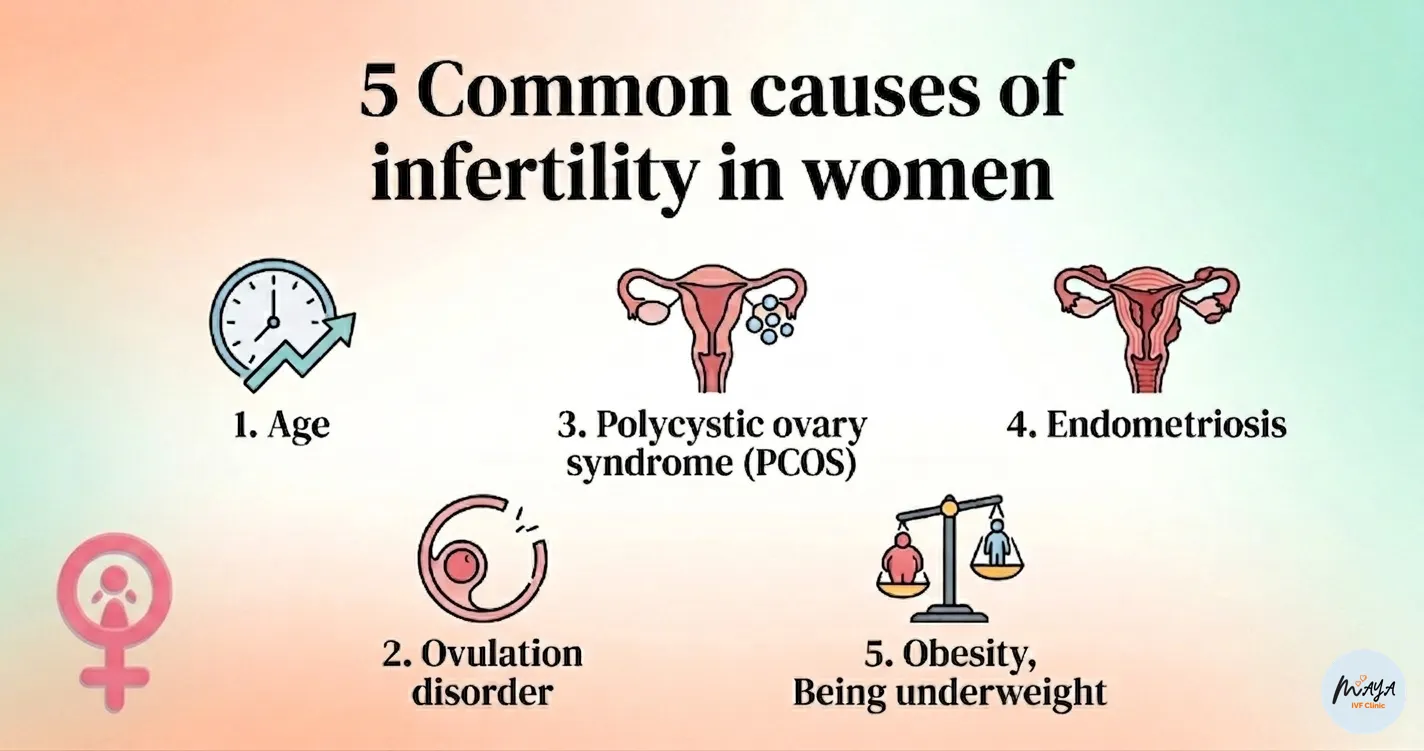
5 Common causes of infertility in women
A condition is diagnosed as infertility when a heterosexual couple is unable to conceive after one y...

 Nepal International Fertility and Laparoscopic Centre (NIFLC).
All rights reserved.
Nepal International Fertility and Laparoscopic Centre (NIFLC).
All rights reserved.